Case study · Retail & E-commerce

Data Warehouse Migration

Context

We built a comprehensive data synchronization and warehousing platform for a thriving e-commerce brand specializing in novelty apparel. The system aggregates fragmented data from Shopify, diverse marketing campaign sources, and internal ERP tools into a single, unified reporting layer. Today the e-shop owners use the platform as their primary source of truth for marketing decisions and for planning manufacturing down to exact product variants and volumes.

SQL ServerAirflowPostgreSQL
Structured, observable orchestration
A clean, version-controlled transformation layer
Automated data quality, built in
Problem definition and goal

The legacy data warehouse — built on SQL Server and orchestrated by Apache Airflow — had grown into an unmaintainable tangle of hundreds of stored procedures, monolithic pipelines with thousands of interdependent tasks, and no version control. Business users stopped trusting the data after encountering duplicate records, conflicting reports, and inconsistencies discovered in client presentations rather than by the engineering team.

The goal: replace it with a platform where data is trustworthy, traceable, and easy to extend.

Industry
Retail & E-commerce
Competencies
Data warehouseData integrationAutomated data qualityPipeline orchestration
Technologies
SQL ServerAirflowPostgreSQLDagsterdbt

Challenges

  1. Fragility at scale

    A single task failure could silently cascade and block entire pipelines for hours. There was no isolation, no clear ownership, and no way to quickly identify what had gone wrong and why.

  2. Unmaintainable transformation logic

    Hundreds of stored procedures with overlapping logic and zero version control made every change a gamble.

  3. Eroded data trust

    Duplicate records, missing values, and cross-source metric mismatches were regularly caught by business stakeholders rather than engineers. There was no systematic data quality layer — quality was everyone's concern and no one's responsibility.

  4. High cost of change

    Integrating a new data source meant navigating an undocumented codebase with no consistent patterns. What should take days took weeks, and each addition introduced new fragility into existing pipelines.

Solutions

We rebuilt the platform end to end on a modern data stack — Dagster for orchestration, dbt on PostgreSQL for transformations — with data trustworthiness as the core engineering priority.

Structured, observable orchestration

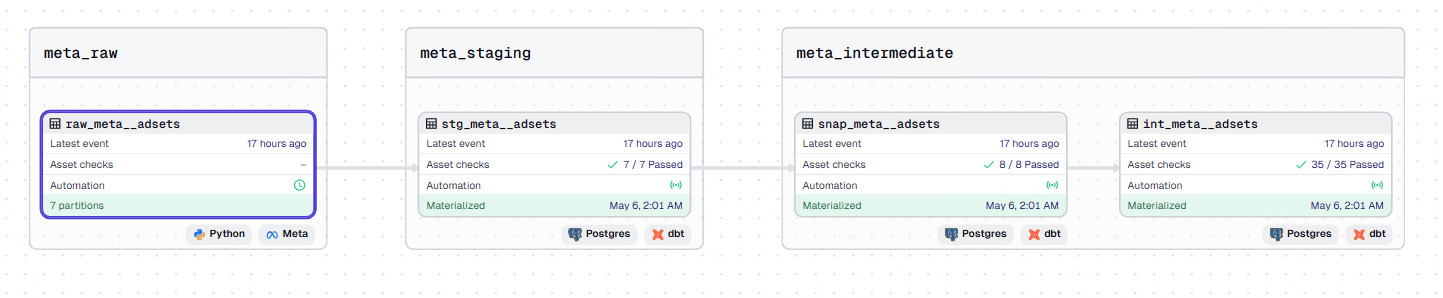
Dagster replaced Airflow as the orchestration engine, with pipelines rebuilt as small, clearly scoped jobs. Every data source follows a consistent, documented module structure — making new integrations predictable and fast, without touching existing code.

Structured, observable orchestration

A clean, version-controlled transformation layer

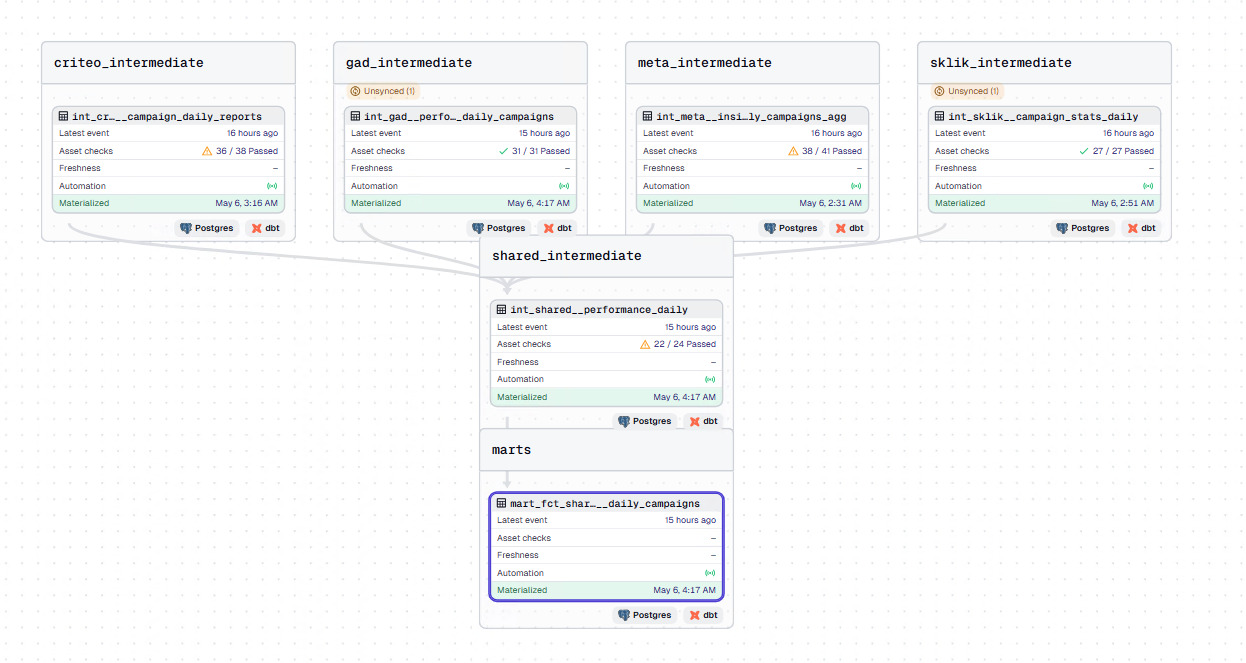
All SQL transformations were rebuilt in dbt using a strict three-layer architecture: staging, intermediate, and marts. Every model is documented, typed, and stored in Git — giving the team a full audit trail and the ability to review any change before it reaches production.

A clean, version-controlled transformation layer

Automated data quality, built in

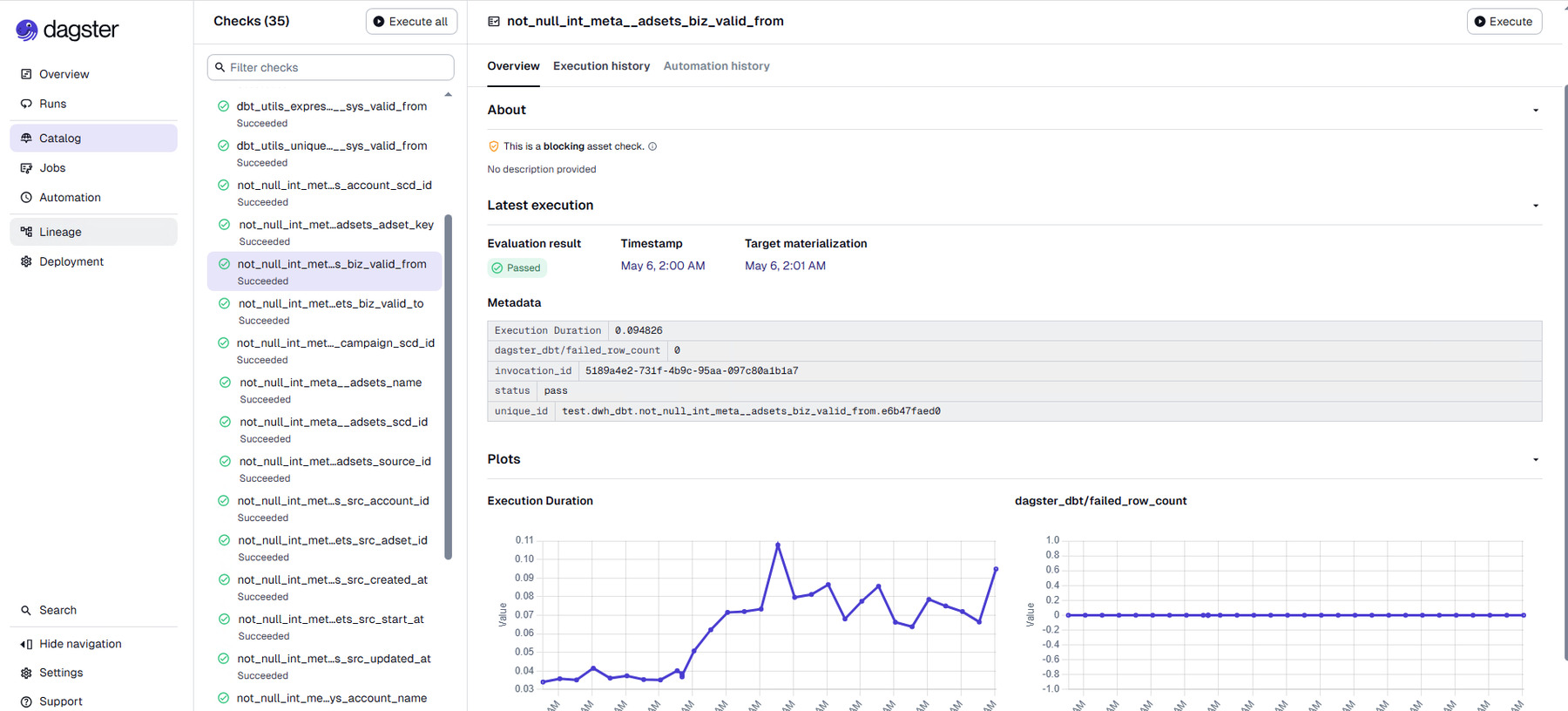
The platform includes two tiers of automated testing: structural checks such as uniqueness, nulls, and referential integrity, and cross-source metric validation — for example, confirming that hourly campaign spend rolls up correctly to daily totals across every integrated advertising platform. Together with alerting and automated re-runs, quality is enforced by the system, not left to chance.

Automated data quality, built in

Flexible data ingestion

Standardized connectors handle data from REST APIs, GraphQL APIs, CSV files, and relational databases under a single consistent framework. Adding a new data source is a matter of following a well-defined pattern, not decoding tribal knowledge.

A foundation for AI-powered analytics

The mart layer is designed with semantic clarity — well-named entities, consistent grain, and clean metric definitions. This makes it directly usable as a knowledge base for large language model tooling: natural language querying, automated report generation, and AI-assisted insight discovery become realistic next steps rather than distant aspirations.

Key features

  • Data warehousing
  • Data integration
  • Automated data quality
  • Pipeline orchestration
  • Analytics engineering
Is this for you?

Your reports disagree. Your decisions shouldn’t.

We rebuilt the data warehouse of a fast-growing e-commerce brand whose business users had stopped trusting the data. The same problem appears wherever data from the shop, marketing and ERP meets in one place.

  • E-commerce and retail
  • Marketing analytics
  • Production planning
  • Data-driven businesses
Sounds familiar?

0 of 5 sound familiar

How we would start

  1. Audit what you havePipelines, sources and the reports people actually rely on.
  2. Rebuild in clear layersSmall, observable jobs and version-controlled transformations in staging, intermediate and mart layers, as with Dagster and dbt on this project.
  3. Test the data automaticallyStructural checks and cross-source metric validation, so errors are caught before the business sees them.
Stopped trusting your data?

Tell us
about your project

Describe what you want to build. We’ll get back to you within 24 hours with a proposal for next steps.

Need more info?

Reach out directly to our project managers, who will be happy to tell you more.

Romana Kovalová