Case study · Healthcare

Dodes

Dodes is the abbreviation for Diagnostic nodes. It is a methodology designed by Prof. Dr. Paul Martin Putora from St. Gallen hospital in Switzerland.

Terminology unification
Comparison trees
Comparison trees
Problem definition and goal

A medical guideline is a document with the aim of guiding decisions and criteria regarding diagnosis, management, and treatment in specific areas of healthcare. These guidelines are updated regularly and are often in the form of “free text” documents.

A healthcare provider is obliged to know the medical guidelines of his or her profession and must decide whether to follow the recommendations of a guideline for individual treatment. It is important to find a way to promote the newest guidelines and draw attention to possible diverges between the guidelines and widespread practice.

Prof. Dr. Paul Martin Putora proposed a method to document the decision-making process in a structured way. He used the decision tree notation that condensed the information in a very efficient and readable way and also allowed to compare the decision-making process between different healthcare providers.

Industry
Healthcare
Competencies
Data analyticsData visualizationMicroservices
Technologies
JavaMySQLSpring StackVueVuetifyApache SolrDockerKubernetesREST

Challenges

  1. Terminology unification

    The treatment decisions are based on parameters which can have different names in different hospitals. Even when the different hospitals use the same names for same parameters, they might express parameter values in different units; for example, glucose can be measured in mmol/l as well as mg/dl. To perform calculations, this terminology had to be unified or at least be mappable.

  2. Comparison trees

    The decision trees can be documented in diverse ways. Some prefer to use complex mathematical expressions to define when a given action is performed when others use simple logical expressions. Some medical centers can omit certain parameters because the measurements for that parameter have not been taken. To find differences in such complicated structures was not trivial.

  3. Huge state-space

    The decision-making comparison has been performed in studies where more than 10 hospitals took part. One treatment can depend on 10+ parameters. To evaluate such state-space, we can easily end up with billions of combinations that need to be evaluated.

  4. Data presentation

    The differences between treatments can be quite profound. It is complicated to get the right insights from the results unless users investigate the result in detail.

Solutions

Terminology unification

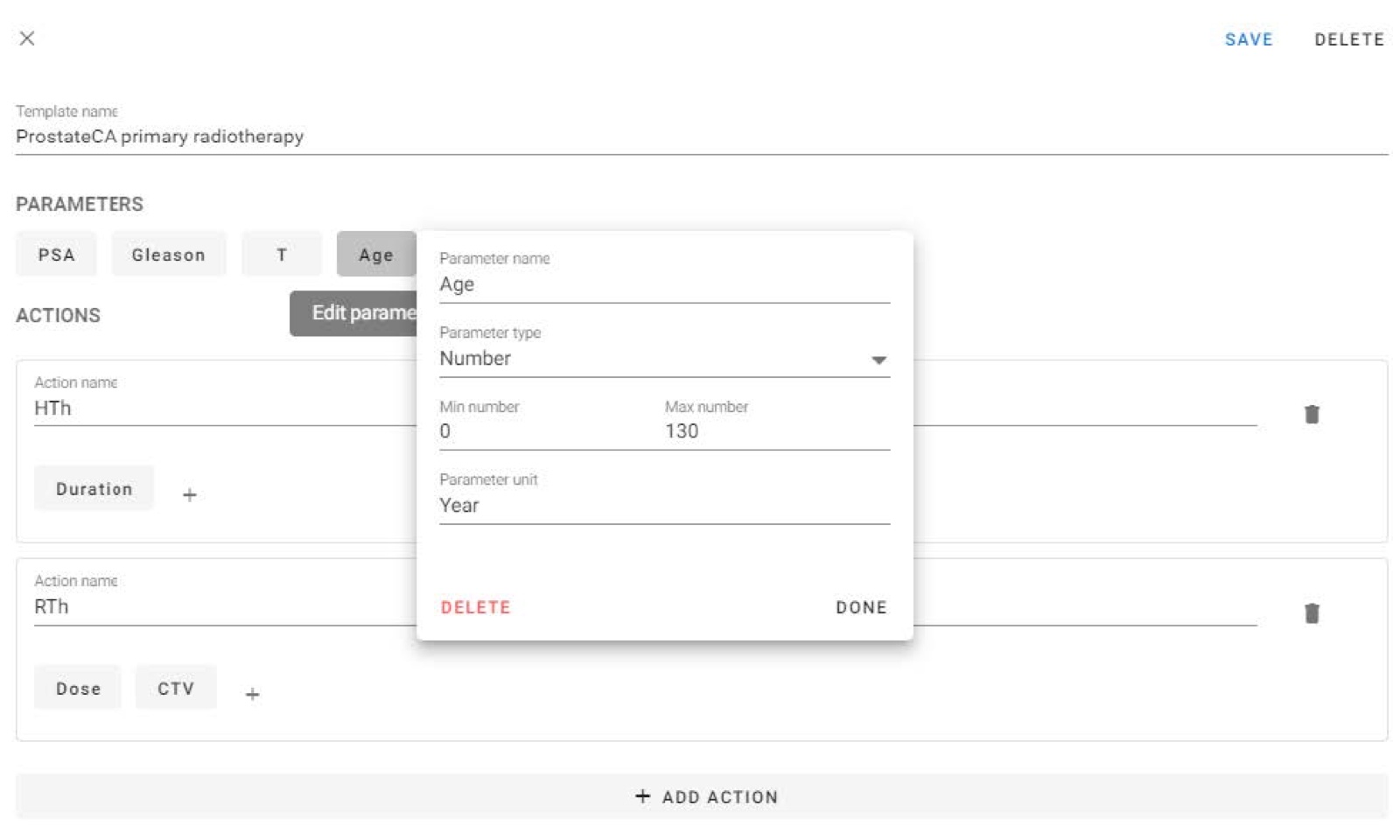
Before the decision tree for a particular treatment can be created the terminology has to be unified in the treatment template. This template defines a vocabulary for decision trees in terms of the parameters that must be considered in the treatment as well as actions that can be performed. When the user is creating a decision tree, the system is using the template to provide guidance and ease the process of input.

Terminology unification

Comparison trees

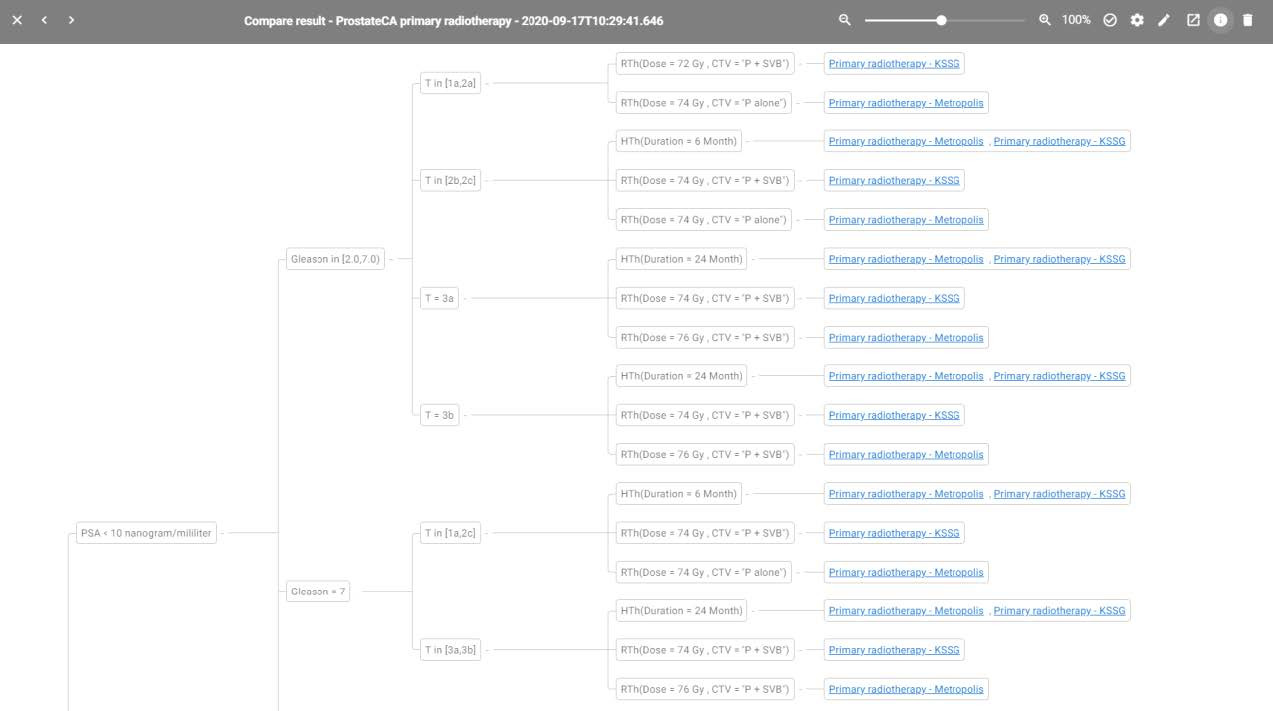
We have implemented algorithms that can transform the decision tree into a multidimensional state-space and can assign each “coordinate” a set of actions for a given parameter range. This allows us to compare each coordinate to find differences. From this information, we can back generate a decision tree that represents comparison results. We can use the same approach to enhanced the validation of decision trees like calculate parameter ranges that do not have any action or have contradictory conditions.

Comparison trees

Huge state-space

To compute large decision trees from many institutions, we have implemented parallelized computation, using the google task queue. The computational state-space is divided into many smaller spaces that are sent to the task queue. This service spans as many computers as needed and performs the computation in parallel, returning results that are merged into a single comparison result. This way, we can perform comparison calculations in near real-time.

Data presentation

To reduce comparison results, users can use filters actions, or parameter values and thus reduce the state-space to much smaller sizes. We are still investigating options to make the comparison result more compressed and readable. Currently, we are experimenting using correlation matrixes.

Key features

  • Data analytics
  • Data visualization
  • Microservices
Is this for you?

Your rules are written as text. Your decisions need structure.

With Prof. Dr. Paul Martin Putora we built Dodes, which turns treatment decisions into comparable decision trees. The same need appears wherever experts follow rules written in free text and practice differs between organisations.

  • Healthcare and clinical research
  • Insurance and claims rules
  • Regulatory compliance
  • Expert decision support
Sounds familiar?

0 of 5 sound familiar

How we would start

  1. Unify the vocabularyA shared template of parameters and values before any decision tree is drawn.
  2. Structure the decisionsDecision trees that can be compared across institutions.
  3. Compute and show the differencesParallel computation for large state spaces, and filters to focus on what matters.
Guidelines buried in free text?

Tell us
about your project

Describe what you want to build. We’ll get back to you within 24 hours with a proposal for next steps.

Need more info?

Reach out directly to our project managers, who will be happy to tell you more.

Romana Kovalová